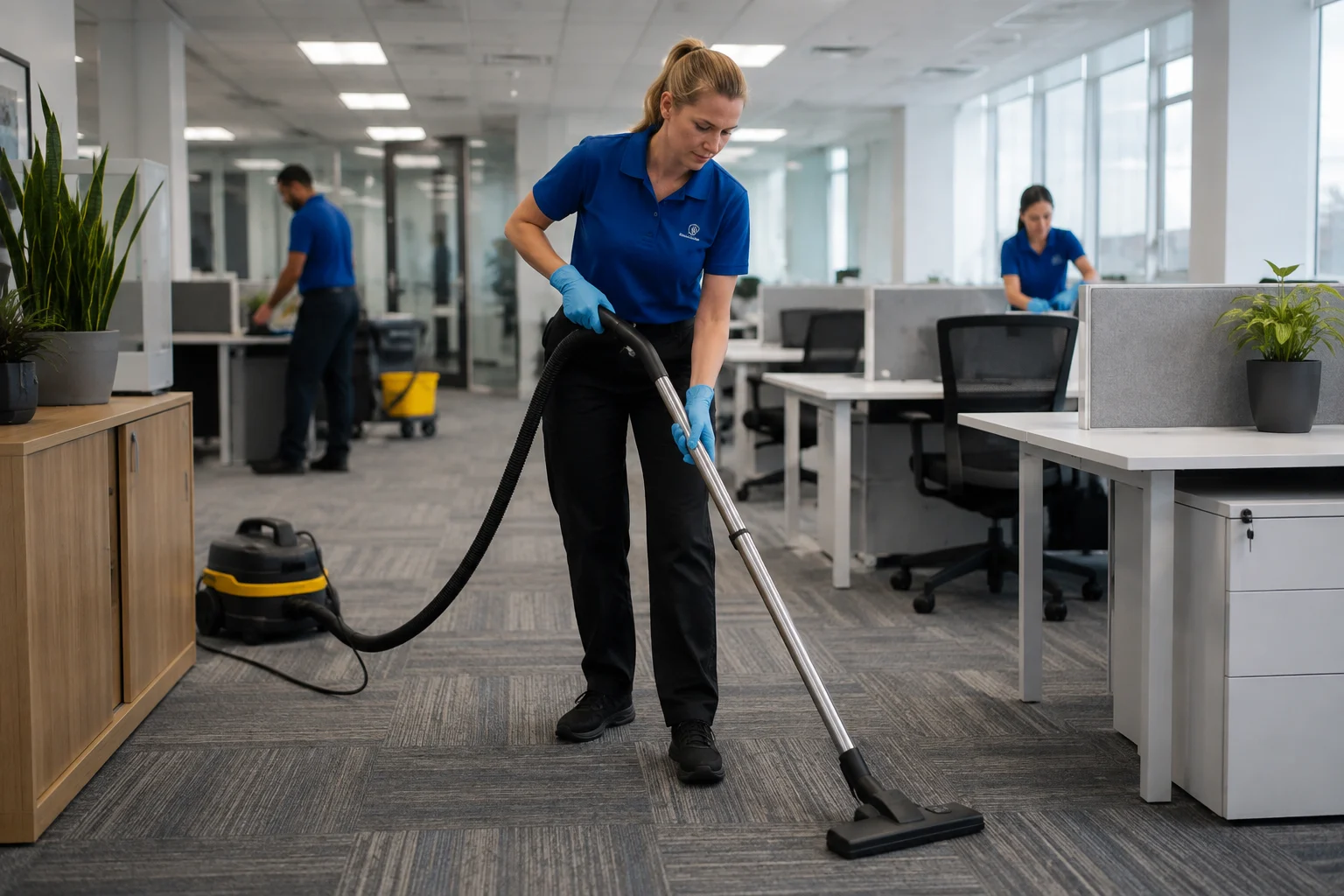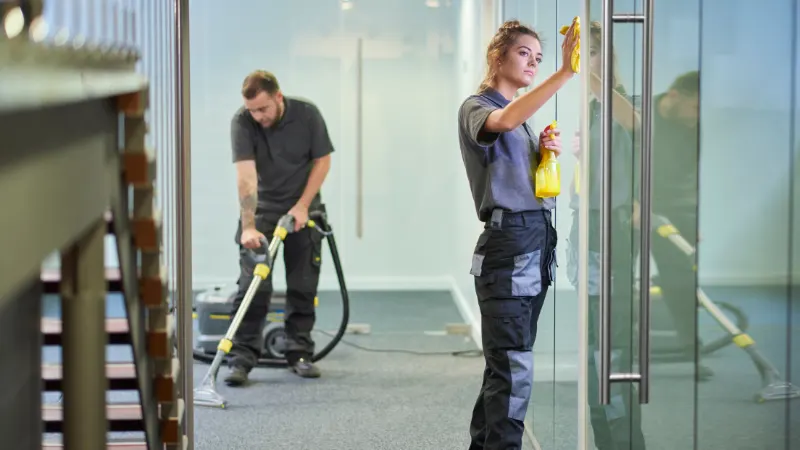
A commercial cleaning scope of work should tell both the facility manager and cleaning provider exactly what the recurring service covers. At minimum, it should identify the spaces being serviced, the work required in each space, how often each task occurs, service days and access requirements, responsibility for supplies and equipment, periodic services, quality-control procedures, and exclusions.
“Clean the office five nights per week” is not a complete scope. It tells you when the crew arrives, but not what happens during those visits.
A stronger scope connects each area with specific work and a defined frequency. That makes the document useful for pricing the account, managing the cleaning team, reviewing performance, and comparing competing proposals.
A Scope of Work Is More Than a Cleaning Checklist
A cleaning checklist and a scope of work serve different purposes.
A checklist may tell a cleaner to empty trash, vacuum carpet, clean restrooms, and mop hard floors. The scope establishes where those tasks apply, when they must be completed, and which party is responsible for related supplies, equipment, access, and periodic work.
For example, “vacuum carpet” leaves several questions unanswered. Does it apply to every carpeted room? Is it completed every visit or only on certain days? Are traffic lanes treated differently from private offices? Is carpet extraction part of the agreement?
A useful commercial cleaning scope answers those questions before service begins.
The simplest way to build one is:
Area → Task → Frequency → Responsibility → Verification
Each part should be specific enough that the customer and cleaning team can determine whether the agreed work was completed.
1. Define the Actual Areas Being Serviced
Start with the cleanable areas rather than relying only on total building square footage.
Two facilities with the same square footage can require very different amounts of cleaning. One may contain large open work areas, while another has dozens of individual offices, multiple restrooms, conference rooms, glass partitions, and a heavily used breakroom.
The scope should identify the spaces included in recurring service. Depending on the property, these may include reception areas, private offices, open workspaces, conference rooms, restrooms, breakrooms, corridors, stairways, entrances, and other common areas.
Restricted spaces should also be identified.
If a records room, server room, executive office, storage area, or secured department is outside the crew’s authorized access, it should not remain ambiguous.
Compare:
Clean approximately 12,000 square feet.
with:
Recurring service covers the reception area, first-floor offices, three conference rooms, four restrooms, employee breakroom, corridors, main entrance, and designated common areas.
The second description gives both sides a usable definition of the property being serviced.
2. Connect Specific Tasks to Specific Areas
Once the areas are established, the scope should define what happens in each one.
Avoid broad phrases such as “general cleaning,” “complete office cleaning,” or “maintain restrooms.” They do not establish enough detail to evaluate the work later.
A simple area-based format works better:
| Area | Work defined in the scope |
| Reception | Empty waste, vacuum or mop flooring, dust accessible surfaces, clean designated entry glass |
| Restrooms | Service fixtures and mirrors, empty waste, clean floors, restock agreed consumables |
| Offices | Empty designated waste, clean scheduled flooring, dust agreed accessible surfaces |
| Breakroom | Service counters, sink, tables, waste containers, and flooring |
| Conference rooms | Empty waste, clean agreed table surfaces, vacuum or mop flooring |
The exact tasks will vary by facility. What matters is that the wording establishes a shared expectation.
This becomes especially important in spaces such as breakrooms. “Clean breakroom” does not tell the customer whether appliance interiors, dishes, cabinets, or refrigerators are included. If those tasks matter, the scope should address them specifically.
3. Give Each Recurring Task a Defined Frequency
A task list without frequencies can still produce an unclear cleaning agreement.
Suppose a scope says:
Dust offices, clean glass, vacuum carpets, clean baseboards.
The work is listed, but nobody knows whether those tasks happen every night, weekly, monthly, or only when requested.
The scope should connect important recurring tasks with a frequency appropriate for the facility.
For example:
| Task | Example scheduling method |
| Restroom service | Each scheduled visit |
| Trash removal | Each scheduled visit |
| Breakroom service | Each scheduled visit |
| High-traffic vacuuming | Each scheduled visit |
| Full office vacuuming | Designated service days |
| Detail dusting | Weekly |
| Baseboard detailing | Monthly |
| Carpet extraction | Separate maintenance schedule |
| VCT refinishing | Agreed floor-care schedule |
These are examples, not universal frequencies. The actual schedule should reflect occupancy, traffic, flooring, operating hours, and the condition the business expects between visits.
Five Cleaning Visits Do Not Mean Every Task Happens Five Times
This distinction is easy to overlook when reviewing a commercial cleaning proposal.
A crew may enter the building Monday through Friday while different tasks follow different rotations.
Restrooms, trash, breakrooms, entrances, and heavily traveled floors may require attention every visit. Private offices might follow a rotating schedule. Detailed dusting may be weekly, while certain floor services occur only periodically.
This allows the labor in each visit to follow how the building is actually used instead of treating every surface as if it has the same maintenance requirement.
It also means that when comparing proposals, the number of weekly visits alone tells you very little about how much work is included.
4. Separate Routine Floor Cleaning From Periodic Floor Maintenance
Floor-care wording deserves particular attention because “floor cleaning included” can describe very different levels of service.
Routine commercial cleaning may cover vacuuming, dust mopping, spot cleaning, and damp mopping. Those tasks maintain the floor during normal janitorial visits.
Periodic maintenance is different.
Depending on the flooring and its condition, a property may also require carpet extraction, tile and grout cleaning, machine scrubbing, VCT burnishing, scrub and recoat service, or stripping and waxing.
Those services can involve different equipment, products, labor, and scheduling.
The scope should therefore distinguish routine work from periodic maintenance.
If carpet is vacuumed during recurring service but extraction is separately scheduled, say so. If VCT is mopped routinely but refinishing follows another maintenance plan, that should also be documented.
This prevents the phrase “floor care” from carrying expectations that were never included in the recurring service.
5. Define Who Handles Cleaning Products, Equipment, and Consumables
A well-written scope separates three things that are often grouped together: cleaning products, cleaning equipment, and building consumables.
Cleaning products are the chemicals and materials used to perform the work. Equipment includes items such as vacuums, carts, mops, and floor machines.
The agreement should identify who provides what, especially when a property has product restrictions or requires specialty equipment.
Consumables require separate treatment. These can include toilet paper, paper towels, hand soap, and trash liners.
For each applicable item, the business should know:
Who purchases it? Who stores it? Who monitors inventory? Who restocks it? Is its cost included in the recurring price?
Supplying and restocking are not necessarily the same responsibility.
For example, the customer may purchase cases of paper towels while the cleaning crew is responsible for refilling dispensers from the stored inventory.
A few lines in the scope can settle an issue that otherwise becomes a recurring operational question.
6. Match the Service Schedule With Building Access
The scope should state the scheduled service days and the time window in which the crew is authorized to work.
For an after-hours account, that may also require documenting access cards, keys, alarm procedures, secured rooms, and an authorized contact for access problems.
Consider a conference room scheduled for nightly cleaning. If that room is regularly locked and the cleaning team does not have authorized access, the written task and the operational reality conflict.
Restricted areas should therefore be identified before service starts.
This section does not need to become a security manual. Its purpose is simply to make sure the agreed cleaning work can actually be performed during the approved service window.
7. Define How the Work Will Be Checked
“Quality service” is not a useful quality-control procedure by itself.
A commercial cleaning scope should establish how service is reviewed and how problems move from observation to correction.
That may include supervisory inspections, a designated customer contact, a method for reporting missed tasks, and a process for addressing recurring concerns.
This distinction matters because not every complaint has the same cause.
If one wastebasket is missed once, the problem may be execution. If several restrooms repeatedly deteriorate before the next visit, the problem may be the service frequency or scope rather than the quality of the previous cleaning.
A defined communication process helps the facility manager and contractor identify which type of problem they are dealing with.
Blue Ribbon Cleaning Company states that its quality-control process includes supervisor inspections, giving Ocala businesses a concrete point to discuss when developing their service scope.
8. Document What the Recurring Price Does Not Cover
The exclusions section is not fine print that should be ignored. It is part of understanding what the quoted service actually buys.
There is no universal list of services that every commercial cleaning contractor excludes. The important point is that work outside the recurring scope should be identifiable.
For example, a facility may need clarification about exterior windows, high-access work, appliance interiors, carpet extraction, floor refinishing, event cleanup, or post-construction cleaning.
These examples should not be interpreted as Blue Ribbon exclusions. They illustrate the types of services that should be addressed rather than assumed.
Floor work provides a good example.
If a proposal includes “routine floor maintenance,” ask whether that means vacuuming and mopping only or whether periodic services are also included. Carpet extraction and VCT stripping and waxing should not be assumed simply because the proposal contains the words “floor care.”
Clear exclusions make future add-on requests easier because both parties know where the recurring agreement ends.
9. Include a Process for Changes to the Facility
The scope that works on the first day of a contract may not fit the property a year later.
A business may take over another suite, increase staffing, add a restroom, extend operating hours, change flooring, or begin receiving substantially more visitors.
Each change can alter the amount or timing of cleaning required.
The process does not need to be complicated:
Identify the change → review its effect on the existing scope → document any service or pricing adjustment → obtain approval → update the scope.
This prevents new responsibilities from accumulating informally.
The same process can be used when building use decreases. If an entire department moves out or hybrid work significantly reduces occupancy, the facility manager can review whether the existing task rotation still makes sense.
10. Compare the Scope Before Comparing Commercial Cleaning Prices
Two monthly prices are only directly comparable when the underlying services are reasonably comparable.
Suppose Contractor A and Contractor B both propose five cleaning visits per week.
Contractor A defines each serviced area, task frequency, periodic floor work, supply responsibility, inspection procedure, and exclusions.
Contractor B lists “janitorial service Monday through Friday.”
The number of visits is the same, but there is not enough information to know whether the amount of work is the same.
This is why a facility manager should normalize competing scopes before evaluating price.
Compare:
areas → tasks → frequencies → periodic work → supplies → access → quality control → exclusions
Then compare the monthly cost.
A lower price may represent less included work. A higher price may include additional work, or it may not. The written scope provides the information needed to determine the difference rather than guessing from the total.
Commercial Cleaning Scope of Work Review Table
Before approving a proposal, a facility manager should be able to answer each of these questions from the document itself.
| Scope element | Question the proposal should answer |
| Service areas | Exactly which rooms and spaces are included? |
| Tasks | What will the crew do in each area? |
| Frequency | When is each recurring task performed? |
| Service window | On which days and during what hours will cleaning occur? |
| Cleaning products | Who provides the products required for routine work? |
| Consumables | Who buys, stores, monitors, and restocks paper products, soap, and liners? |
| Equipment | Who provides standard and specialty equipment? |
| Floor maintenance | Which work is routine and which services are separately scheduled? |
| Access | How will secured and restricted areas be handled? |
| Quality control | Who checks the work and how are issues addressed? |
| Exclusions | Which services are outside the recurring agreement? |
| Additional work | How is one-time work requested and approved? |
| Changes | How is the scope updated when the facility changes? |
If the proposal cannot answer several of these questions, getting clarification before approving the agreement will make the service easier to manage later.
Prepare for the Walkthrough Before the Scope Is Written
The strongest scope usually starts before the proposal is drafted.
When requesting commercial cleaning in Ocala, provide the contractor with information about the property that affects the actual workload.
Instead of simply saying the building is 15,000 square feet, identify which portions require cleaning. Know the number of restrooms and breakrooms, the primary flooring materials, operating hours, typical occupancy, visitor patterns, and any restricted areas.
Also point out where the current cleaning program struggles.
Perhaps the lobby floor requires more attention than the private offices. A busy restroom may need service during every visit. Carpeted entrances may have a different maintenance need from low-traffic conference rooms. Existing VCT may require periodic care beyond routine mopping.
Those observations help turn the walkthrough into a facility-specific scope rather than a standard task list.
Developing a Commercial Cleaning Scope for an Ocala Facility
Blue Ribbon Cleaning Company has served the Ocala area since 1985 and provides recurring janitorial and commercial floor-care services.
For a new commercial cleaning account, the useful starting point is the property itself: which spaces require service, how those spaces are used, what flooring is present, and what the customer expects to be completed during each visit.
That information can then be translated into an area-by-area scope and service schedule. Periodic needs such as commercial carpet cleaning, tile and grout cleaning, and VCT floor care can also be identified separately from routine janitorial work.
The objective is not to put more tasks on paper. It is to make the written scope accurately reflect the work the facility requires.
Request a Commercial Cleaning Walkthrough in Ocala
If your current proposal only tells you the monthly price and number of cleaning visits, review what those visits actually include before making a decision.
Blue Ribbon Cleaning Company can walk through your Ocala facility, identify the cleanable areas, discuss task frequencies and floor-care requirements, and develop a scope around the property’s actual service needs.
Blue Ribbon Cleaning Company
821 NE 36th Terrace, Suite 7
Ocala, FL 34470
Phone: 352-624-0460
Request a commercial cleaning quote to discuss the service scope for your facility.
Frequently Asked Questions
What is included in a commercial cleaning scope of work?
A scope should identify the serviced areas, tasks, frequencies, service schedule, supplies and equipment responsibilities, access requirements, periodic services, quality-control process, exclusions, and procedures for additional work.
What is the difference between a cleaning checklist and a scope of work?
A checklist identifies tasks. A scope connects those tasks to specific areas, frequencies, responsibilities, service conditions, quality-control procedures, and exclusions.
Should every cleaning task have a frequency?
Important recurring tasks should have an understood frequency. Defining whether work occurs each visit, weekly, monthly, or periodically reduces uncertainty about what the recurring service includes.
Are restroom paper products included in commercial cleaning?
There is no universal arrangement. The scope should specify who purchases consumables such as toilet paper, paper towels, soap, and liners, who restocks them, and how they are billed.
Is carpet cleaning included in routine janitorial service?
Do not assume that it is. Routine carpet vacuuming and professional carpet extraction are different tasks. The scope should identify whether extraction is included or separately scheduled.
Does routine floor cleaning include stripping and waxing?
Not necessarily. Routine mopping and VCT stripping and waxing require different work. Periodic floor services should be identified separately when they are part of the maintenance plan.
What happens when the building’s cleaning needs change?
The existing scope should be reviewed when occupancy, operating hours, serviced space, flooring, or other relevant conditions change. Any ongoing service adjustment should then be documented.
How should I compare commercial cleaning proposals?
First compare the areas, tasks, frequencies, periodic services, supply responsibilities, access requirements, quality-control procedures, and exclusions. Once the scopes are comparable, compare pricing.
Should excluded cleaning services be listed in the scope?
Yes. Clearly identifying work outside the recurring agreement reduces uncertainty and establishes which services require separate scheduling or approval.
How can Blue Ribbon develop a scope for my facility?
A walkthrough can be used to identify cleanable areas, building use, flooring, task requirements, and appropriate service frequencies. Those details can then form the basis of the proposed cleaning scope.