A medical office cleaning checklist can look detailed and still leave important questions unanswered. It may list surfaces without identifying whether they need cleaning or disinfection, when the task should happen, who is responsible, or how completion will be checked.
For practice managers, the goal is to turn those individual tasks into a usable system. Exam rooms, waiting areas, and restrooms have different functions and contact patterns, so the checklist should reflect those differences instead of applying one generic routine throughout the office.
What Should a Medical Office Cleaning Checklist Include?
A medical office cleaning checklist should identify the area being cleaned, the exact task, the required treatment, when it should occur, who handles it, and how completion is confirmed.
A practical checklist can use this framework:
Room → Surface or Task → Clean or Disinfect → Timing or Trigger → Responsible Role → Product or Procedure → Verification
At minimum, include:
- Room or zone: Exam room, waiting area, reception, restroom, or another defined space.
- Surface or task: Specify exactly what needs attention rather than writing a vague instruction such as “clean room.”
- Cleaning or disinfection requirement: Distinguish routine cleaning from tasks requiring an appropriate disinfectant.
- Timing or trigger: Define whether the task is scheduled, based on use, or triggered by visible contamination or another condition.
- Responsible role: Identify whether the task belongs to environmental cleaning staff, clinical staff, or another assigned role.
- Product or procedure: Reference the facility procedure or appropriate product instructions when needed.
- Verification: Include a sign-off, inspection, or other method of confirming completion.
The CDC’s Core Infection Prevention and Control Practices emphasize environmental cleaning based on factors such as patient contact and the degree of soiling. A room-specific checklist can therefore be more useful than a single generic task list for an entire medical office.
Suggested Visual: Medical office checklist framework showing Room → Surface → Treatment → Timing → Responsibility → Verification.
Is Cleaning the Same as Disinfecting in a Medical Office?
No. Cleaning and disinfection are different processes, so a medical office checklist should not use the terms interchangeably.
| Cleaning | Disinfection |
| Removes soil and contamination from surfaces | Uses an appropriate antimicrobial product or process on a surface |
| May be sufficient for some routine environmental surfaces | May be needed where facility procedures or contamination conditions call for it |
| Helps prepare a surface for further treatment when needed | Must follow applicable product directions, including contact time |
CDC environmental guidance distinguishes routine cleaning from environmental disinfection and gives greater attention to frequently touched surfaces than to minimal-touch surfaces.
This does not mean every object in a medical office should automatically be disinfected the same way. The appropriate treatment depends on the surface, patient contact, contamination, and the facility’s procedures.
Using precise wording also prevents terms such as cleaning, sanitizing, disinfecting, and sterilizing from becoming interchangeable instructions.
Suggested Visual: Cleaning vs. disinfection comparison graphic.
What Should Be Prioritized in Exam Rooms, Waiting Areas and Restrooms?
Medical office cleaning priorities should reflect how each room is used, how often surfaces are touched, whether patients come into contact with them, and whether visible contamination is present.
| Area | Main Cleaning Priorities | Key Planning Consideration |
| Exam room | Patient-contact and frequently touched environmental surfaces, visible soil, floors | Clearly separate environmental cleaning from clinical equipment responsibilities |
| Waiting and reception area | Shared touchpoints, seating, counters, entrance surfaces, floors | Consider patient and visitor traffic |
| Restroom | Toilets, sinks, faucets, handles, doors, floors, supplies | Give appropriate attention to frequently touched fixtures |
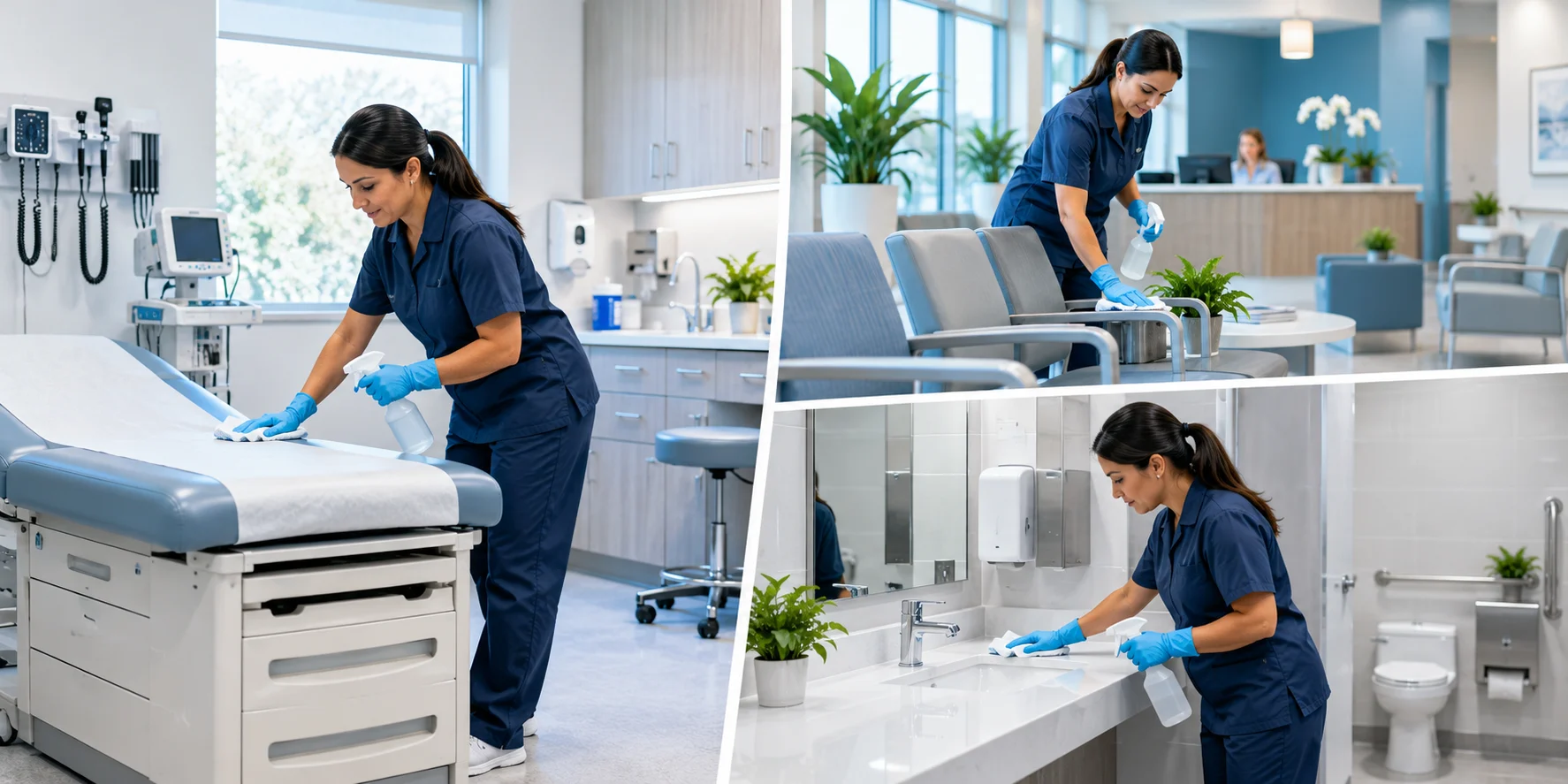
Exam Room Cleaning Checklist
An exam room checklist should focus on environmental surfaces that receive patient or frequent hand contact, while clearly identifying which responsibilities belong to clinical staff.
Depending on the facility’s procedures, the checklist may include:
- exam table exterior where appropriate;
- countertops;
- sink and faucet handles;
- door handles;
- light switches;
- chairs;
- assigned noncritical equipment surfaces;
- floors;
- visible soil or contamination requiring attention.
A common mistake is assuming that every object inside an exam room belongs to the environmental cleaning team. Reusable patient-care equipment may require specific reprocessing procedures and clearly assigned responsibilities.
Waiting and Reception Area Cleaning Checklist
A waiting and reception area checklist should focus on shared surfaces, visible soil, patient-facing areas, and floor condition.
Potential checklist items include:
- entrance and door handles;
- chair and seating touchpoints;
- reception or check-in counters;
- shared surfaces;
- touch devices where facility policy permits environmental cleaning;
- flooring;
- visible spills and debris.
Waiting areas differ from exam rooms because they are shared patient and visitor spaces rather than rooms used primarily for direct clinical encounters.
Medical Office Restroom Cleaning Checklist
A restroom checklist should address frequently touched fixtures, toilets, sinks, floors, doors, and supply levels according to facility procedures.
Potential items include:
- sink surfaces;
- faucets and handles;
- toilet fixtures;
- flush controls;
- door handles;
- floors;
- consumable supplies.
CDC environmental infection-control recommendations give greater attention to frequently touched surfaces than to minimal-touch housekeeping surfaces.
Blue Ribbon Cleaning Company’s current medical-facility service includes patient and exam rooms, waiting and reception areas, and restroom areas, which are the same core zones addressed in this checklist.
Suggested Visual: Three-part checklist graphic for exam rooms, waiting areas, and restrooms.
How Often Should Medical Office Cleaning Tasks Be Completed?
Medical office cleaning frequency should be based on patient contact, touch frequency, visible soil, contamination, room use, procedures, and facility-specific requirements rather than one universal schedule.
Important factors include:
- how frequently patients or staff touch the surface;
- the amount of patient or visitor traffic;
- whether visible soil is present;
- whether contamination has occurred;
- the function of the room;
- procedures performed in the space;
- the facility’s established cleaning procedures.
A checklist can therefore use different timing categories, such as:
- recurring scheduled cleaning;
- between-use or event-triggered cleaning;
- contamination-triggered response;
- periodic detail cleaning.
Where OSHA’s Bloodborne Pathogens Standard applies, employers must determine and implement an appropriate cleaning schedule based on factors including the location, type of surface, type of soil, and tasks or procedures performed in the area. The OSHA Bloodborne Pathogens Standard should be read in its proper workplace context rather than treated as a universal medical-office cleaning timetable.
Consider a hypothetical clinic with several heavily used exam rooms and a lower-contact administrative area. Applying the same timing to every surface would ignore the differences in patient contact and room use.
For broader planning, Blue Ribbon’s guide on how often professional commercial cleaning is needed provides additional frequency context.
How Do Disinfectant Labels and Contact Time Affect the Checklist?
When disinfection is required, the checklist or underlying procedure should account for the appropriate EPA-registered product and its label directions, including the required contact time.
Contact time is the period specified on the product label during which the treated surface must remain wet for the disinfectant’s labeled use.
The U.S. Environmental Protection Agency’s disinfectant guidance explains that registered disinfectants should be used according to their label directions. Those directions include information such as approved uses and contact time.
For a practical checklist, “disinfect surface” may therefore be too vague by itself. The facility may need to identify:
- the applicable product or procedure;
- the surfaces for which it is appropriate;
- required label directions;
- required contact time;
- any surface-compatibility considerations.
Avoid assuming that spraying a product and immediately wiping it away satisfies every disinfectant label.
Who Should Be Responsible for Each Medical Office Cleaning Task?
Each medical office cleaning task should have a clearly assigned role, and environmental cleaning staff should not automatically be assigned responsibility for every piece of reusable patient-care equipment.
A checklist should identify whether the task belongs to:
- environmental or janitorial cleaning staff;
- clinical staff;
- another specifically assigned role.
Responsibility should reflect facility procedures, equipment instructions, and staff training.
CDC Core Infection Prevention and Control Practices address appropriate reprocessing of reusable medical equipment and the need for clearly assigned responsibilities. That distinction matters because an exam room may contain both ordinary environmental surfaces and equipment requiring a separate clinical reprocessing procedure.
Consider a hypothetical exam room containing a countertop, chair, door handle, and reusable patient-care device. The countertop and touch surfaces may fall within the environmental cleaning scope, while the reusable medical device may have its own reprocessing procedure. The checklist should make that responsibility explicit rather than leaving it open to assumption.
How Can You Turn the Checklist Into an Accountable Cleaning Scope?
Turn the checklist into an accountable cleaning scope by defining each task, assigning responsibility, specifying its timing or trigger, and adding a completion or inspection process.
A practical scope can include:
- Room or zone
- Surface or task
- Cleaning or disinfection requirement
- Schedule or trigger
- Responsible party
- Relevant procedure or product instruction
- Completion or sign-off
- Inspection or exception reporting
This structure can help an office manager use the same checklist for internal procedures, staff responsibilities, and vendor expectations.
If an outside provider is involved, the checklist can also support a clearer commercial cleaning scope of work by defining what the provider is expected to handle rather than relying on broad instructions such as “clean the medical office.”
Blue Ribbon states that its medical-facility cleaning work includes monitoring and inspections as part of its quality-control process. Medical practices evaluating recurring professional service can review Blue Ribbon’s medical facility cleaning services to see how the service relates to a defined cleaning scope.
For medical offices in Ocala that are ready to discuss their facility’s actual cleaning requirements, Blue Ribbon also provides an option to request a customized cleaning quote.
Frequently Asked Questions
Should Every Surface in a Medical Office Be Disinfected?
No. The appropriate treatment depends on factors such as patient contact, surface use, contamination, and facility procedures. CDC guidance distinguishes frequently touched surfaces from minimal-touch surfaces rather than treating every surface identically.
Does a Medical Office Need a Written Cleaning Schedule?
Where OSHA’s Bloodborne Pathogens Standard applies, employers must determine and implement an appropriate written cleaning schedule based on factors such as location, surface, soil, and procedures performed. Other facility-specific requirements may also apply.
Are Exam-Room Floors Treated the Same as High-Touch Surfaces?
No. Floors are not functionally the same as frequently touched patient-contact surfaces. Cleaning or disinfection decisions should reflect contamination, room use, and the medical office’s established procedures.